K-SAT OPTIMIS Enterprise OS

K-SAT OPTIMIS Enterprise OS

The AI operating system where nine department agents share one memory, built for small and mid-sized businesses

K-SAT OPTIMIS Enterprise OS is a multi-tenant AI operating system that gathers a small or mid-sized company's daily work into one place. Every tenant gets its own roster of agents; these are not separate tools but a team sharing a common memory core.

The flow runs one way: an inbound contact β€” phone, WhatsApp, SMS or e-mail β€” lands in a single inbox, is routed by rule to the right desk, and becomes an operation (appointment, work order, quote, stock); a separate branch works outward, turning signals into leads. Overnight, everything that happened during the day is consolidated into memory.

No risky step is taken silently. The approval layer can only ever make the system more cautious, never bolder.

Next.jsReactTypeScriptSupabasePostgreSQL / RLSDeno Edge FunctionsClaudeVapiStripeTailwind CSS
K-SAT OPTIMIS Enterprise OS

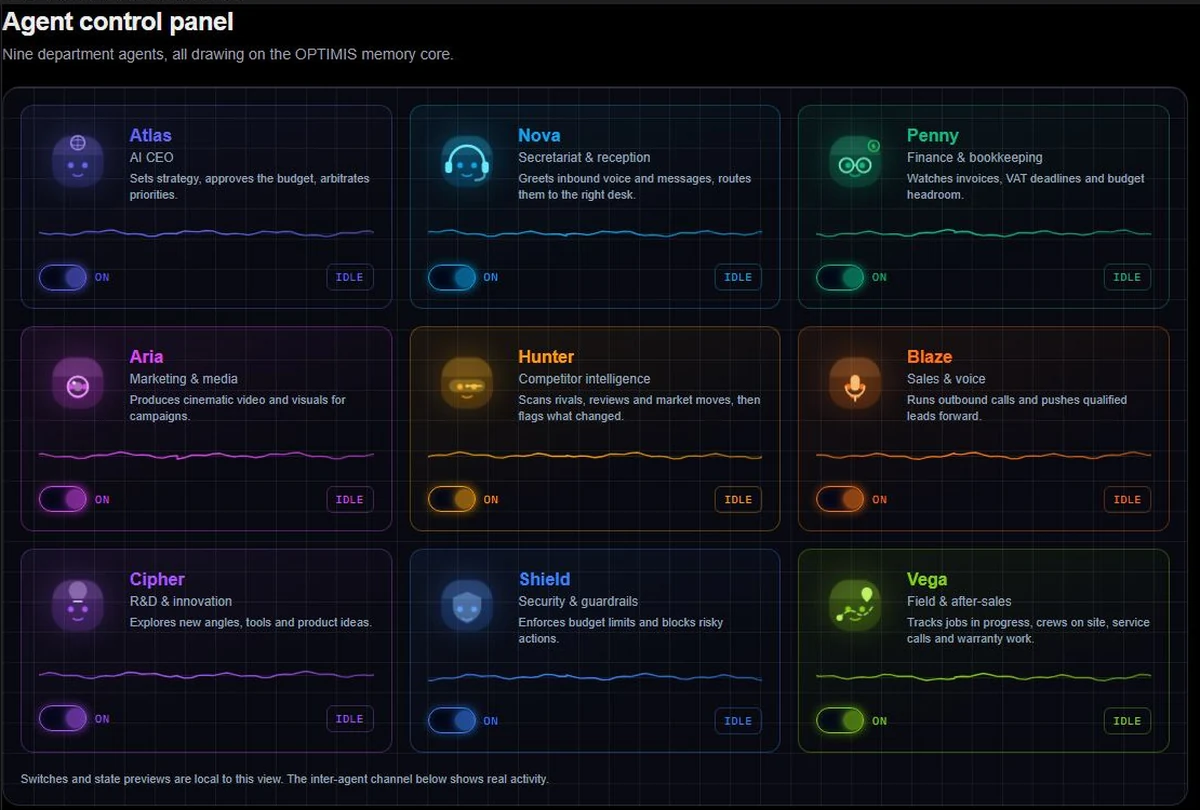
Nine department agents, one memory

Each agent has a job, a personality and its own toolset β€” but all of them read the same company memory.

  • Strategy and direction. A leading agent that sets priorities, approves the budget and arbitrates between the others.
  • Reception and routing. A secretariat agent that greets inbound voice and messages and passes them to the right desk.
  • Finance. A bookkeeping agent that watches invoices, VAT deadlines and budget headroom.
  • Marketing, sales and field. A marketing agent producing campaign visuals and video; a sales agent running outbound calls and pushing qualified leads forward; a field agent tracking jobs in progress, crews on site and warranty work.
  • Competition and R&D. An intelligence agent that scans rivals, reviews and market moves and flags what changed; an R&D agent exploring new angles and product ideas.
  • Security. A guardrail agent that enforces budget limits and blocks risky actions.
  • A shared memory core. What one agent learns, another can use on the next job; no agent starts from nothing.
Nine department agents, one memory β€” K-SAT OPTIMIS Enterprise OS

One inbox and rule-based routing

Whatever the channel, the conversation accumulates in one place.

  • Four channels, one stream. Voice calls, WhatsApp, SMS and e-mail land in the same conversation inbox; if the customer switches channel, the history does not break.
  • Routing is done by rule, not by a model. Having a language model classify every message costs money per message. OPTIMIS routes with deterministic rules β€” cheaper and predictable.
  • Outbound and inbound together. Incoming mail is polled, reply drafts are prepared, and sending and delivery problems are handled separately.
  • Reply classification. Incoming answers are sorted into interest, refusal or question and fed back into the matching campaign step.

Per-tenant voice assistants

What answers the phone is not a switchboard menu but an assistant compiled from the company's own knowledge.

  • The assistant is compiled from the company profile. Each tenant's own company information and knowledge packs go into how the assistant speaks: not a generic bot, but that company's assistant.
  • A separate assistant per role. Distinct assistant configurations run for reception, sales and service.
  • Inbound and outbound calls. The system does not only pick up; it also places scheduled outbound calls.
  • The call becomes a record and a flow. Recording, transcript and outcome land in the same conversation inbox and attach to the operation.

Operations β€” appointments, work orders, quotes, stock

A conversation has to turn into work somewhere; in OPTIMIS that somewhere is the same system.

  • Appointments and calendar. Creating, querying and cancelling appointments; upcoming deadlines and reminders run from one place.
  • Work orders and staff. An order is opened, assigned to an employee, and its state in the field is tracked.
  • Quotes and VAT. A quote is prepared, VAT computed, and the fate of the quote is queryable.
  • Stock and supply. Stock checks, movement records and purchase orders are part of the same flow.
  • Documents and reminders. Company documents are queryable, and time-bound obligations are attached to a reminder.

Growth β€” from signal to customer

The outward branch scans what is happening around the business and queues up the opportunity.

  • Signal collection and scoring. Maps, job postings, social media and review sources are scanned; the resulting signals are scored and ranked.
  • Signal to lead, lead to customer. A qualified signal becomes a lead, and a lead that progresses becomes a customer; every stage is recorded.
  • Campaign execution. A lead is enrolled in a campaign; e-mail and call steps run to plan.
  • Competitor and review tracking. Competitors are saved, their reviews and shifts in sentiment are followed, and the strategic read is built from that.
Growth β€” from signal to customer β€” K-SAT OPTIMIS Enterprise OS

Media and content production

Marketing work does not leave for another tool; it stays inside the same system.

  • Images, video and flyers. Campaign visuals, videos and template-based flyers are requested through the agent.
  • Scenarios and a content queue. Content scenarios are drafted, refined and placed in the publishing queue.
  • Social publishing and performance. A post is scheduled and published; account and performance data are read back.
  • Comment management. Incoming comments are monitored and a reply is drafted β€” sending goes through approval.

Nightly memory consolidation

The system works through the day; at night it files what it learned.

  • Consolidation. The day's conversations, jobs and outcomes are gathered overnight and written into durable memory.
  • Overnight insight. Findings from consolidation are presented as insights ready by morning.
  • Self-improvement. The system evaluates its own output and flags recurring mistakes.
  • Memory is queryable. Agents do not freely recall the past; they read memory through an explicit query, which keeps the origin of every element traceable.

Governance, security and white-label

A business system is judged by what happens when it gets something wrong.

  • Human approval (HITL). Risky actions β€” outbound messages, publishing, expensive generation, deletions, billing β€” stop and wait for approval.
  • The guardrail only ever brakes. The approval layer can make the system more cautious; under no circumstances bolder.
  • Row-level isolation (RLS). Multi-tenant isolation is enforced in the database, not in the interface: a tenant sees only its own data.
  • Multilingual by design. The interface is kept in six languages and the translation keys are checked by the compiler; a missing translation cannot reach production unnoticed.
  • White-label and subscriptions. Every tenant works under its own brand; subscription plans and billing are part of the system.

Getting started

  1. Tenant profile. Your company details, your services and your knowledge packs are entered β€” that is what the agents' speech is compiled from.
  2. Connecting the channels. Phone number, WhatsApp, SMS and mailbox are connected; routing rules are written around your actual desks.
  3. Operations setup. Appointment types, work-order flows, quote templates and stock items are defined.
  4. Pilot department. One real week on a single department β€” usually reception and appointments β€” with approval thresholds tuned to it.
  5. Roll-out. The remaining agents open one at a time; the growth and media branches go last, because they speak outward.

Could this run at your company?

Describe your operation in two lines. You get a costed scope back, not a brochure.

Or call us directly +32 460 25 64 64
WhatsApp Β· Brief 24h