
SAGA AI WhatsApp Assistant

SAGA AI WhatsApp Assistant

An assistant that understands your customers β€” and says nothing you have not allowed

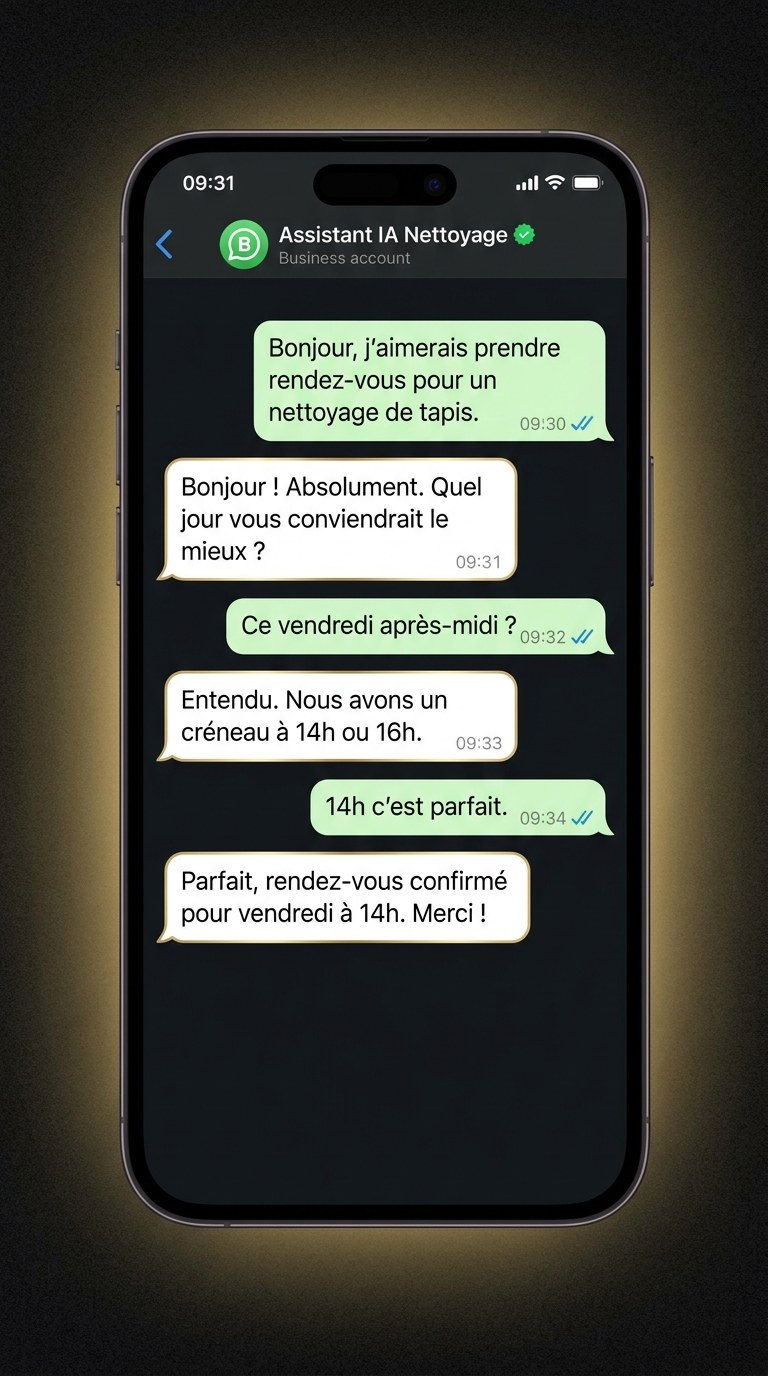
Your customers already write on WhatsApp. The K-SAT assistant answers them there β€” in English, French, Dutch or Turkish, in the language of the message it received, with no menu and no keyword to type.

What separates it from a chatbot is not the conversation; it is what sits behind it. The wording of every reply lives in a database rather than a prompt, a chain of checks refuses to let an inconsistent message out, and no new rule takes effect until a human has approved it.
n8nEvolution APISupabasePostgreSQLClaudeTelegram Bot APIWhatsApp Business
SAGA AI WhatsApp Assistant

Four languages, nothing for the customer to learn

  • Detected automatically. English, French, Dutch and Turkish. The assistant replies in the language of the incoming message; the customer picks nothing.
  • The language stays locked. A lone "ok" or "yes" in the middle of a conversation does not flip the assistant into another language.
  • Plain sentences, no menu. A normally written message is enough β€” there is no number to press and no keyword to remember.
  • Voice notes. When a voice message cannot be made out, the assistant says so and asks for text, instead of asking again for something already given.

From the question to the booking, with no operator

The assistant does more than reply: it fills in a file. Every detail the customer gives β€” name, address, quantity, material, dimensions β€” is kept and never asked for twice.

  • Service area, live. The postcode is pulled from the address the customer typed, then checked against the database: is the zone served, what is its minimum order value, which day is it collected on.
  • A calculated quote, never a guess. Until quantity, dimensions, material and postcode are all known, the assistant asks for what is missing. It does not offer an approximate price.
  • The appointment is created. As soon as the customer agrees, the slot is booked and stored, on a day that is genuinely available for that zone.
  • It re-reads its own messages. An address or a date the assistant itself announced earlier in the conversation is never asked for again.
  • A same-day pickup never goes through on its own. That case is passed to an operator β€” it is an operations decision, not an automatic reply.
From the question to the booking, with no operator β€” SAGA AI WhatsApp Assistant

You approve before the customer sees it

The assistant can run under human approval: it prepares the reply, you get it on Telegram, and nothing leaves before you act.

  1. The customer writes on WhatsApp.
  2. The assistant prepares a reply that fits the conversation so far.
  3. You receive the customer's message and the proposed reply on Telegram.
  4. You decide, and the reply goes out on WhatsApp.

Three buttons, three outcomes:

  • Send β€” the reply goes as written.
  • Edit β€” you write your own; yours is what reaches the customer, and it becomes something to learn from.
  • Refuse β€” the customer gets a holding message and the case returns to a human.

Two guard rails that matter day to day:

  • If you do not answer within fifteen minutes, the customer receives an acknowledgement β€” not the assistant's unapproved reply. Outside service hours that message goes straight out.
  • Several messages in a row are grouped into one notification with the full context, rather than one alert per message.

How much is held for approval is a setting. You start with everything, open up the simple replies once you trust them, and step back at any time.

It learns from your corrections β€” and still never decides alone

Correcting the assistant twice on the same subject ought to be enough. That is what the learning loop is for.

  • A correction becomes a proposed rule. When an operator corrects a message with the /duzelt command, a second model reads the correction and works out whether it is a general rule or an exception specific to that customer.
  • Nothing takes effect without a human. A proposed rule is stored as pending and inactive. It applies only after an explicit /onay, and /reddet archives it. That is a guarantee of the system, not a preference.
  • Everything is recorded. Every correction is logged β€” the wrong message, the correction, the decision β€” whether or not a rule came out of it.
  • The operator keeps the pen. /kural adds a rule directly, /kurallar lists the active ones, /sil removes one.

A doubtful reply does not go out

Between the reply being written and being sent, a chain of checks reads it back. A check that finds an inconsistency stops the send and raises an alert, rather than letting an error reach the customer.

  • What was booked and what is announced must agree. If the stored slot is Wednesday, the reply has to say Wednesday. Otherwise it does not go.
  • Price and measurement checks before any figure is quoted.
  • No empty replies. A bare "thanks!", an acknowledgement with no content, or a sentence near-identical to one of the previous two messages is rejected.
  • Silence is a valid answer. A simple thank-you or a thumbs-up at the end of a conversation does not trigger an automatic summary.
  • One source of truth. The workshop address, the accepted payment methods and the served zones come from the database; the assistant cannot invent a variant.

The content lives in the database, not in a prompt

  • A light model to understand, code to decide. The AI pulls the intent and the details out of the message; everything after that β€” the arithmetic, the sequencing, the choice of reply β€” is deterministic code, so it can be tested and reproduced.
  • Your wording and your prices are database rows. Changing a message, a zone or a minimum order takes no prompt edit and no redeployment.
  • It does not go quiet. If the database does not answer, the assistant falls back on a local copy of its wording and its zones rather than sending an empty message.
  • A health report every week. System integrity, the last 24 hours' error rate, corrections processed and rules waiting on your decision β€” sent automatically.
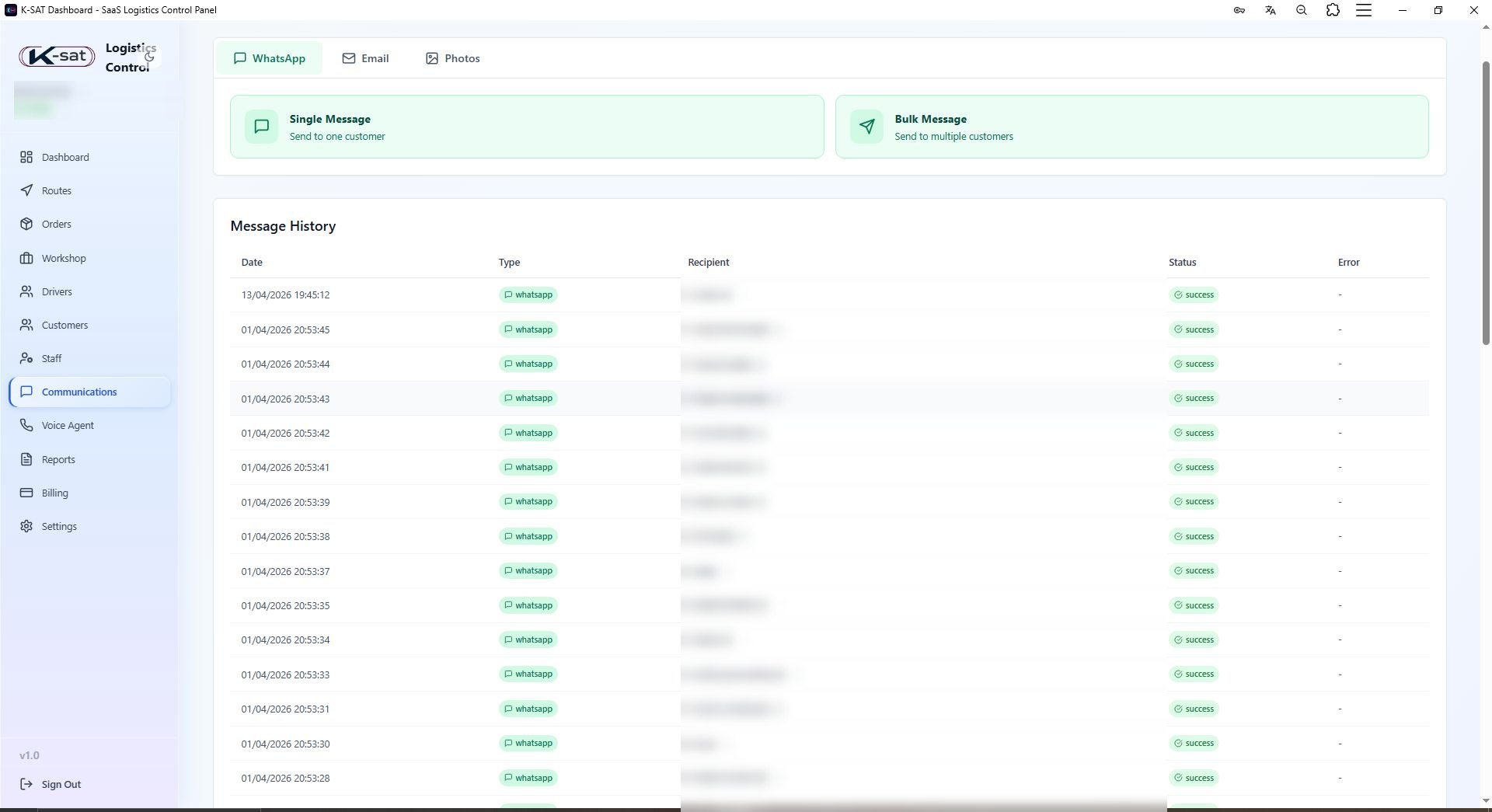
  • It fits what you already run. WhatsApp Business through Evolution API, n8n automations, data on Supabase, supervision on Telegram. It works on its own, or as the front door to the K-SAT Logistics ERP.

Getting started

  1. Your rules first. Zones, prices, collection days, address and payment methods β€” that is what the replies are built on, and it lives in the database from day one.
  2. Connection. WhatsApp number linked, Telegram approval channel opened for your operators.
  3. Full control. You approve every reply. The assistant learns how you phrase things, and you see exactly what it would have sent.
  4. Opening up. You let the replies you trust go out on their own and keep approval on the rest.
  5. Continuous tuning. The weekly report shows you what is sticking; the pending rules are waiting on one word from you.

Could this run at your company?

Describe your operation in two lines. You get a costed scope back, not a brochure.

Or call us directly +32 460 25 64 64
WhatsApp Β· Brief 24h